Thrift Store Fashion: What to Actually Look For

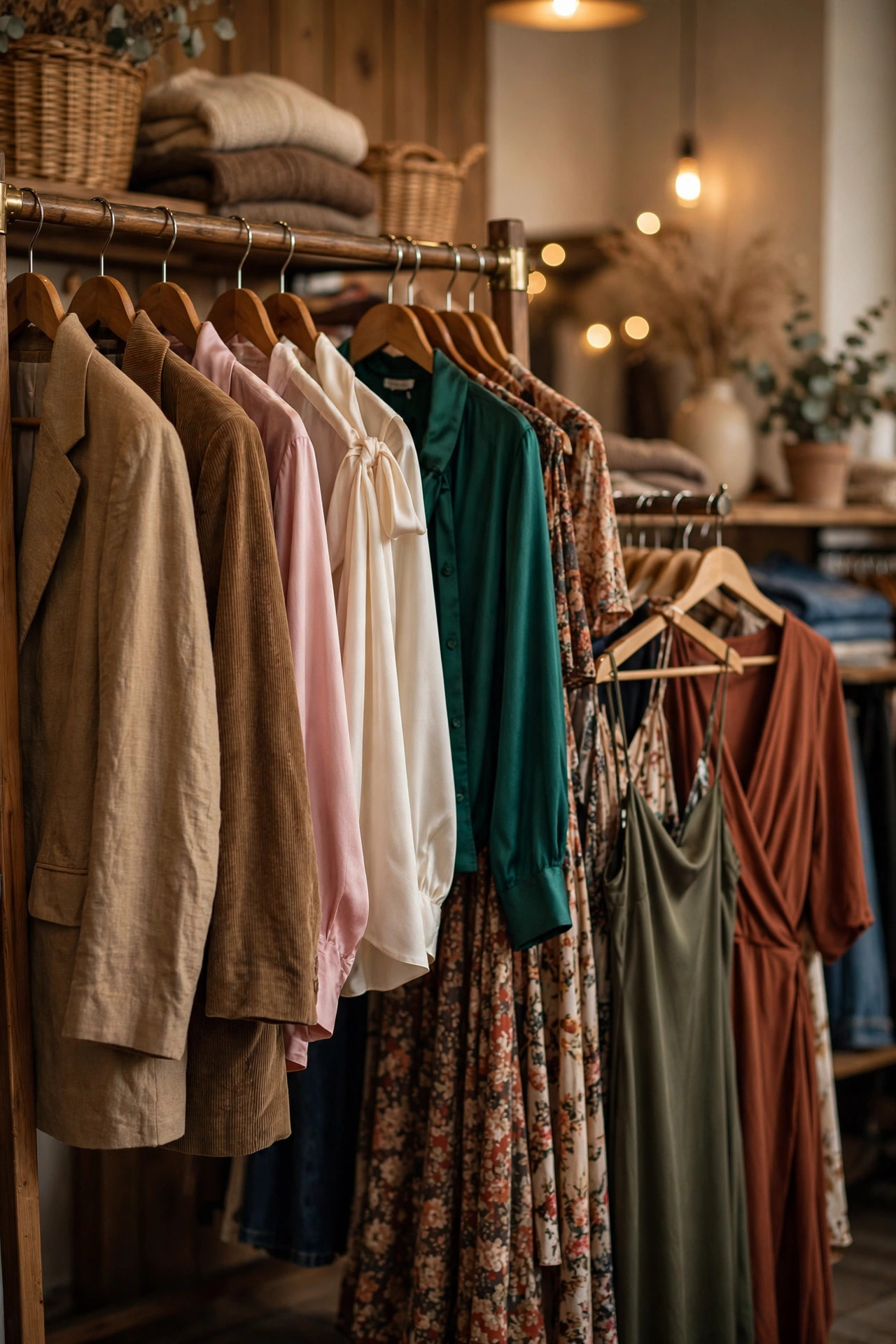
Most people thrift wrong. They wander every aisle for two hours, try on fourteen things that almost fit, and leave with a bag of $4 regrets. The people who walk out looking like they spent $400 have a system: they know exactly which racks pay off, which fabrics are worth the gamble, and which items to put back no matter how tempting the price.
This guide is that system. You will learn the order to shop the store in, the fabric labels that signal quality from across the room, the labels actually worth grabbing, a fit-check you can do in ten seconds, and the items you should always skip. At the end there is a sample $60 haul — ten pieces that prove what a disciplined trip looks like.
Hit the Sections in This Order
1. Coats and blazers. This is where thrift stores crush retail. A wool-blend coat that costs $200 new sits at $15–$25 here. Wool, cashmere blends, and structured blazers age well and photograph expensive. Always start here because the good ones get grabbed first.
2. Shoes and boots. Leather boots, loafers, and heels in barely-worn condition are everywhere. Check the soles — light wear means they were donated after one season. Avoid anything with cracked leather or worn-down heels; resoling costs more than the shoe.
3. Silk, cashmere, and wool knits. Feel every sweater. Cashmere, merino, and silk blends have a softness you can identify blindfolded. These fabrics retail for $80–$200 and thrift for $5–$8.
4. Dresses and skirts. Simple silhouettes in good fabric — midi skirts, slip dresses, shirt dresses. Avoid anything with heavy beading or boning, which is hard to alter.
5. Denim. Jeans and jackets, always. Denim lasts forever and the best washes are often discontinued ones you can't buy new.
6. Handbags, belts, and scarves. Accessories are the fastest win: real leather belts for $3, silk scarves for $2, structured handbags for under $10.
Skip the fast-fashion tee wall almost entirely. A $3 shirt that was $8 new is not a deal — it's clutter with a price tag.
Fabric and Brand Labels Worth Grabbing
Ignore the brand name for a second and read the content label. Grab anything that says 100% silk, cashmere, merino wool, linen, or leather. For blends, look for the natural fiber listed first — a "60% wool, 40% polyester" blazer is a genuine find, while "100% polyester" almost never is, with rare exceptions for vintage pieces.
As for brands: mid-tier mall brands are the thrift sweet spot. Labels like J.Crew, Banana Republic, Ann Taylor, Madewell, and Everlane were built from decent fabrics and tailored cuts, and they flood donation bins. Designer labels do show up, but don't pay a premium just for a name — a $40 thrifted designer top with a stain is worse than a $6 J.Crew one in perfect shape. Condition beats label every single time.
The 10-Second Fit Check
Before anything goes in your cart, run this check. Shoulders: seams should sit at or just past your shoulder bone — everything else can be altered, shoulders can't (cheaply). Length: sleeves and hems can be shortened for $10–$15 at a tailor; too-short cannot be fixed. Buttons and zippers: test every one in the aisle; a stuck zipper is a project, not a purchase. Smell and stains: hold it to your nose and check underarms, collars, and crotch areas in good light. Musty is fixable with a vinegar soak; perfume and smoke are not. The sit test: for pants and skirts, sit down in the fitting room — waistbands that dig or hems that ride up will never get worn.
What to Skip (No Matter the Price)
Put it back if: the fabric is pilling across the whole garment (spot-pilling can be shaved; all-over pilling is done), there are underarm stains or stretched-out necklines, it's a trendy piece from three seasons ago that you'll wear twice, swimwear or undergarments of any kind, shoes with collapsed insoles, or anything that needs more than one alteration. A $5 item that needs $30 of tailoring is a $35 item that still might not fit. Also skip anything you wouldn't buy at full price in a regular store — "it's only $4" is how closets fill with clothes you never wear.
What You'll Need
A disciplined $60 thrift haul — ten pieces, one trip:
- Wool-blend blazer $8
- Silk blouse $5
- Cashmere crew-neck sweater $6
- Genuine leather belt $3
- Pleated midi skirt $4
- Oversized denim jacket $7
- Structured handbag $9
- Leather ankle boots $12
- Gold-tone earrings $2
- Silk scarf $4
How to Do It
- Go on restock days. Ask the staff when new donations hit the floor — usually weekday mornings. The best pieces last hours, not days.
- Shop with a list, not a mood. Write down three specific gaps ("black ankle boots, size 8", "camel sweater") before you go. Lists turn wandering into hunting.
- Scan by fabric first. Run your hand along the rack and pull only what feels like silk, wool, cashmere, linen, or leather. Your fingers are faster than your eyes.
- Check the content label second. Confirm the fabric, then check the brand. Natural-fiber-first blends from decent mall brands are your bread and butter.
- Run the 10-second fit check. Shoulders, length, zippers, stains, smell. Anything that fails goes back on the rack immediately — no "maybe" pile.
- Try on the finalists only. You should be trying on five things, not twenty-five. Do the sit test for bottoms and check everything in natural light near the door.
- Set a hard budget and stop. Bring $60 in cash or set a phone reminder. A budget forces decisions; without one, you'll rationalize the whole rack.
Budget Breakdown
| Item | Cost |
|---|---|
| Wool-blend blazer | $8 |
| Silk blouse | $5 |
| Cashmere crew-neck sweater | $6 |
| Genuine leather belt | $3 |
| Pleated midi skirt | $4 |
| Oversized denim jacket | $7 |
| Structured handbag | $9 |
| Leather ankle boots | $12 |
| Gold-tone earrings | $2 |
| Silk scarf | $4 |
| Total | $60 |
Before & After
Before: Thrift trips feel like gambling. You spend two hours, try on a mountain of almost-right clothes, and come home with things you wear once. Your closet has volume but no outfits, and "thrifting" quietly costs you $40 a month in mistakes.
The shift: You start shopping in order — coats, shoes, knits, dresses, denim, accessories — scanning by fabric and checking labels and fit before anything enters the cart. You carry a list and a hard budget, and the "maybe" pile disappears.
After: One $60 trip yields a wool blazer, silk blouse, cashmere sweater, leather boots, and six more pieces — every one of which you'd have paid ten times more for new. Getting dressed gets easier because everything you own was chosen on purpose.
Tips
- Check the men's section for oversized blazers, flannels, and sweaters — often better quality for less money.
- Look behind the front of each rack; good pieces get pushed to the back by hurried shoppers.
- Bring a tape measure and know your key measurements — sizes vary wildly across brands and decades.
- Wash everything before wearing: hot water for sturdy fabrics, a vinegar soak for musty smells.
- Befriend one tailor. A $12 hem turns a $6 pair of pants into a perfect fit.
Frequently Asked Questions
- How do I know if a thrifted item is good quality?
- Read the content label: natural fibers (silk, wool, cashmere, linen, cotton, leather) signal quality far better than brand names do. Then check the seams — straight, tight stitching and finished edges mean it was built to last.
- Is it sanitary to wear thrifted clothes?
- Yes, once washed. Run sturdy items through hot water, hand-wash delicates, and add a cup of white vinegar to kill musty odors. Skip swimwear, undergarments, and anything with stains you can't identify.
- When is the best time to go thrifting?
- Weekday mornings right after restock — ask staff for their schedule. Early October and January are peak donation seasons, when closets get cleaned out and the racks are fullest.